
The structural changes that matter most are the ones geometry can't see.
FoldShield++ detects mutation impact, fold switching, and conformational shifts using symbolic topology – catching what TM-score, RMSD, and LDDT systematically miss.
Not a replacement for AlphaFold or ESMFold. The analysis layer that runs on top.

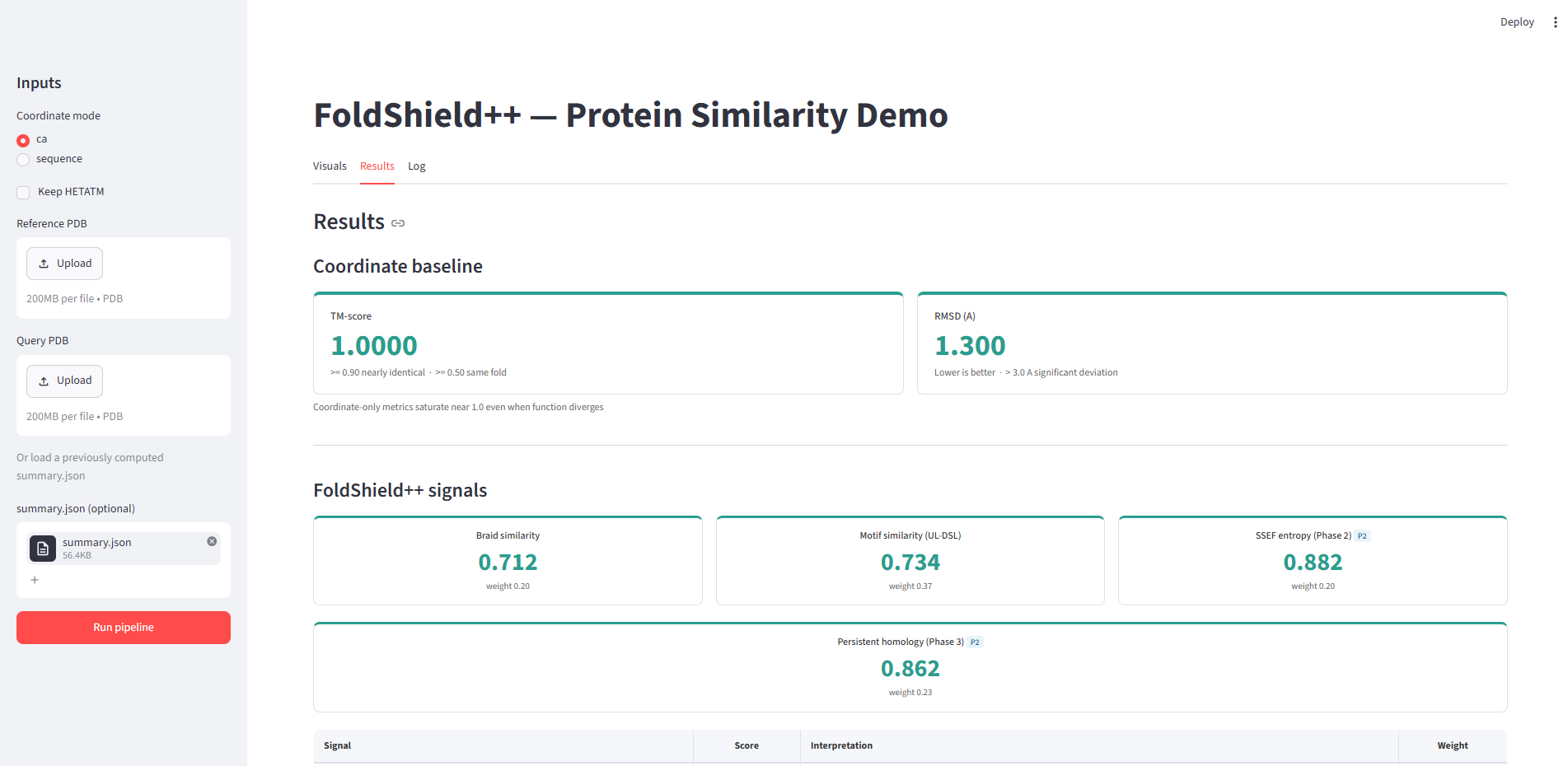
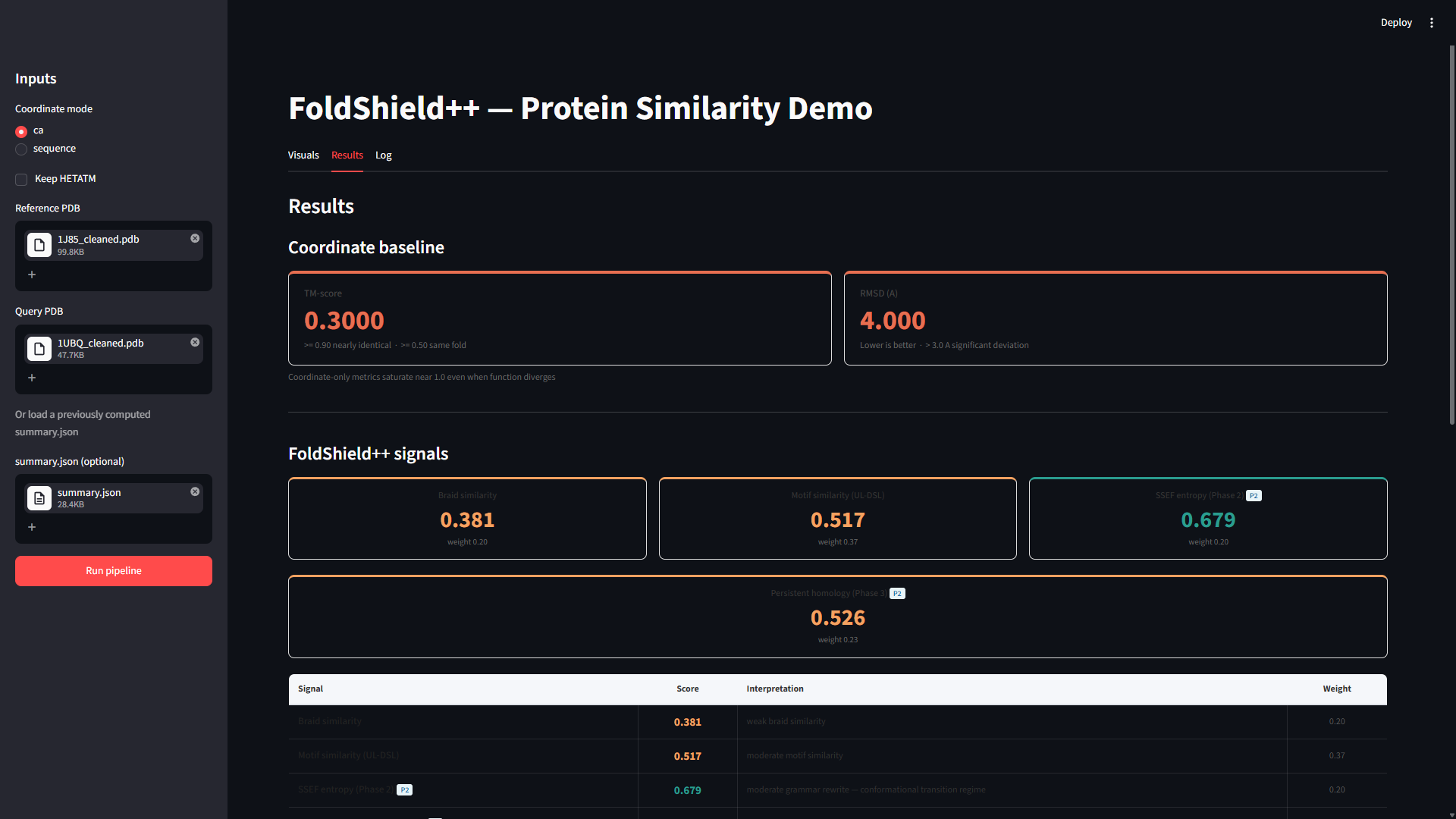
A single mutation can abolish a protein's function while TM-score stays above 0.97
TM-score, RMSD, and LDDT are foundational tools. But they share a common blind spot: they measure coordinate overlap, not structural grammar. When geometry barely changes but function does — which is precisely the case in the most clinically important mutations — these tools return a false negative.
Pearson Correlation
Pass Rate
With TM-score on curated benchmark
ROC-AUC
Pass Rate
Fold discrimination on 50-pair benchmark
Killer Pairs Detected
Pass Rate
High-difficulty cases where TM-score gives no signal
CATH-S20 AUC
Pass Rate
Large-scale fold discrimination on nonredundant dataset
| TM-Score | RMSD | FoldShield++ | |
|---|---|---|---|
| KRAS WT vs G12C | 0.97 — "Nearly identical | < 1 Å — No signal | Topology window shift + entropy spike at P-loop |
| Interpretation | No change detected | No change detected | Switch-I dynamics altered — known drug target mechanism |
| BRCA1 WT vs C61G | 0.93 — "Highly similar" | Small deviation | Symbolic entropy spike + motif topology change at coordination site |
| Interpretation | Structurally normal | Structurally normal | Zinc coordination destroyed — E3 ligase activity abolished |
What This Validates
Structural similarity preserved
Mutation impact remains interpretable
Cross-family separation maintained
Symbolic topology remains stable
Folding behavior captured without MD simulation
Problem Statement
A single mutation can abolish a protein's function while TM-score stays above 0.97.
TM-score, RMSD, and LDDT are foundational tools. But they share a common blind spot: they measure coordinate overlap, not structural grammar. When geometry barely changes but function does—which is precisely the case in the most clinically important mutations—these tools return a false negative.
KRAS G12C·TM-score > 0.97, RMSD < 1 Å.
Switch-I dynamics altered. Drug target.
BRCA1 C61G·TM-score ≈ 0.93.
Zinc coordination destroyed. E3 ligase activity abolished.
SERCA + SLN·TM-score barely moves.
Regulatory function fundamentally shifted.
In each case, geometry says nothing changed.
Biology says everything changed. FoldShield++ reads the structural grammar — not just the coordinates.
What FoldShield++ Does
Four signals. One score. Full interpretability.
Mutation Impact Detection
01Identifies damaging variants by analyzing symbolic divergence and topological shifts—not just coordinate geometry. Detects subtle disruptions that TM-score cannot surface. Validated on BRCA1/2, KRAS, and TP53—the genes where geometry-only tools most frequently fail to explain pathogenicity.
Fold Classification and Structural Separation
02Classifies proteins using topological invariants and symbolic motifs, enabling clean separation of homologs from analogs. Achieved 0.841 AUC on CATH-S20 large-scale nonredundant benchmark. Supports large-scale annotation of predicted proteomes where geometry-based clustering saturates.
Conformational State Detection
03Detects the difference between active and inactive states, open and closed conformations, and regulatory-bound versus unbound structures—without molecular dynamics simulation. Validated on adenylate kinase open/closed, GLP-1R activation states, and SERCA with and without sarcolipin.
Interpretable Signal Breakdown
04Every FoldShield++ score decomposes into four readable signals: braid topology, motif entropy, local topology windows, and persistent homology. You can ask which region diverged, how much, and why—not just whether two structures are different. Designed to complement, not replace, existing scalar stability predictors.
Who Uses FoldShield++
Built for researchers, biotech teams, and AI platform builders who need explainable structural intelligence.
Researchers
01Interpretable per-signal scores, reproducible benchmarks, and honest AUC numbers on nonredundant datasets. Designed to hold up under peer review.
Biotech & Pharma
02Mutation impact scoring on clinically relevant genes (BRCA1/2, KRAS, TP53) without molecular dynamics. Faster variant triage, earlier in the pipeline.
Platform Builders
03Symbolic and topological encodings are discrete and compressible—designed for search and clustering at scale. Runs on top of AlphaFold and ESMFold outputs.
FAQs
What is Foldshield++?
The exponential growth in protein structure predictions—driven by AlphaFold2 and ESMFold—has created an urgent need for analysis tools that can scale beyond traditional geometric comparisons. Conventional metrics such as Root Mean Square Deviation (RMSD), Template Modeling Score (TM-score), and DALI alignments, while foundational, suffer from critical limitations: sensitivity to minor deviations, inability to capture dynamic behaviors, and poor interpretability in clinical and regulatory contexts.